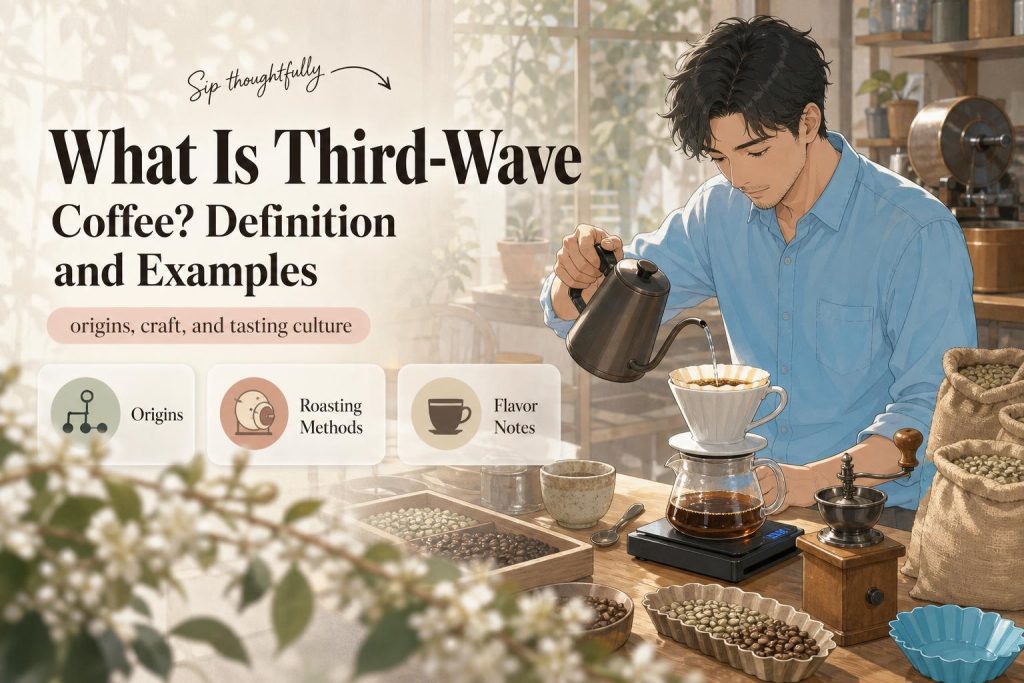
You order a coffee and the barista asks a question back: the washed Ethiopian or the natural Colombian? Then she tells you the farm's name, mentions that the beans were roasted nine days ago, and says the Ethiopian tastes like lemon tea. That exchange is third-wave coffee in practice. Third-wave coffee is an approach that treats coffee as a craft product with a traceable origin rather than an anonymous commodity. It pays close attention to who grew the beans, how they were processed, how they were roasted and brewed, and how the cup tastes. It is a movement and a set of values. It is not a bean grade or a certification you can verify on a label.
The short version
Third-wave coffee is a craft-centered coffee culture that values transparency about origin, careful roasting, precise brewing and attention to flavor. It overlaps heavily with specialty coffee but describes a philosophy, while specialty coffee is a broader quality category. The term also names an Indian café chain, Third Wave Coffee, which is a separate thing.
How third-wave coffee works, from farm to cup
The easiest way to understand the movement is to follow a bag of beans backward from your cup. Each step is a place where a third-wave roaster or café makes a deliberate choice and then tells you about it.
- Sourcing. The roaster buys from an identified farm, cooperative or region, often through a direct relationship with the producer, and names that source on the bag.
- Processing. The method used to remove the coffee cherry from the seed (washed, natural, honey) is disclosed, because it shapes flavor as much as geography does.
- Roasting. Roast profiles are tuned to each coffee rather than pushed dark enough to taste uniform. Roast dates appear on the bag.
- Brewing. Baristas weigh doses, control water temperature and grind size, and often use manual methods such as pour-over alongside espresso.
- Tasting. The coffee is described with flavor notes like citrus, chocolate or stone fruit.
That last step confuses a lot of people. Those notes describe aromas and flavors the coffee produces on its own. Nobody adds fruit or cocoa.
I call the overall pattern "the label test." If a bag tells you the farm or region, the process and the roast date, you are looking at third-wave thinking, whatever the shop calls itself. If it tells you only "Bold House Blend," you are probably not.
First, second and third wave compared
The "waves" framework is commonly credited to roaster Trish Rothgeb, who used it in a 2002 article. It is shorthand, and it simplifies a lot of history. It still helps explain what changed and why Starbucks keeps coming up in these conversations.
| Wave | Rough era | What it prized | Recognizable example |
|---|---|---|---|
| First | Mid-20th century | Convenience and shelf stability | Canned pre-ground coffee, instant coffee |
| Second | 1970s onward | Espresso drinks, café culture, branding | Starbucks, founded in Seattle in 1971 |
| Third | Late 1990s to 2000s onward | Origin, producer, roast precision, flavor | A café pouring a named single-origin coffee by hand |
| Fourth (debated) | 2010s onward | Science, sustainability, producer economics | Not yet a settled category |
Seattle matters here because it shows how the waves feed each other. The city's second-wave chains taught American customers to pay café prices for espresso. Roasters such as Intelligentsia in Chicago, Stumptown in Portland and Counter Culture in Durham then built on that habit by asking customers to care where the beans came from. On X, a recurring view holds that the movement started in the U.S. and later shaped respected European shops, though Scandinavian roasters were pushing light, origin-led roasting at the same time. As a result, it has no single home city.
Whether a "fourth wave" exists is still an open question. People use the term for everything from lab-grade water chemistry to farmer profit-sharing. Until it describes something you can see in the cup or on the bag, I would treat it as marketing.
Is third-wave coffee the same as specialty coffee?
No, though the overlap is large. Specialty coffee is a quality category built around green-coffee grading and cup scoring, which the Specialty Coffee Association defines in detail. Third-wave coffee is a set of values about transparency and craft. Most third-wave cafés sell specialty coffee, but plenty of specialty coffee is sold without any third-wave storytelling.
That distinction matters when you read market data, because the numbers below describe specialty coffee broadly, not third-wave coffee specifically.
The base is enormous. Two-thirds of Americans (66%) drank coffee in the past day in spring 2025, according to the SCA's summary of the National Coffee Association's National Coffee Data Trends report. Younger adults are the heaviest specialty drinkers. That same NCA breakout found 64% of 25 to 39 year olds had a specialty coffee in the past week, the highest share of any age group.
Where people drink it differs too. Among past-day specialty drinkers, 35% had their coffee made outside the home, compared with 20% of traditional-coffee drinkers, which is why café quality shapes the movement so heavily.
In Canada the picture is moving toward cold drinks. Circana's CREST Canada data for the 12 months ending August 2025 shows iced and cold brew at 16% of foodservice coffee servings, up 13% year over year. Hot specialty coffee, meanwhile, slipped 2% to a 17% share, so cold coffee is now within a point of overtaking it. Cities with active food scenes, as covered in our look at culinary events in Toronto, tend to show these shifts first.

What third-wave coffee is not
The most common misconception is what I call the premium-equals-authentic trap: the belief that real third-wave coffee has to be rare, expensive, light-roasted, single-origin and brewed by pour-over. None of those is required.
The roast-level assumption is the easiest to disprove. In the NCA breakout, 62% of past-day specialty drinkers chose medium roast, a share reported as up 35% since 2020. Many respected roasters sell medium roasts that are origin-transparent and carefully developed.
Blends belong in the conversation as well. Coffee Intelligence describes micro-lots as typically 7 to 50 bags of green coffee. That is a small, experimental volume that builds a roaster's reputation but cannot carry the business. Blends and higher-volume single origins supply the consistency that keeps a café's espresso tasting the same in March as in October.
Warning: The most expensive coffee on a menu is not automatically the most "third-wave." A $9 rare-varietal pour-over and a $4 well-made espresso from a transparent blend can reflect the same values. Judge by what the café tells you, not by the price.
A worked example: what traceability costs
Here are real numbers from one well-known roaster. At the time of writing, Blue Bottle's subscription page listed its Single Origin Assortment at $27 and its Blend, Espresso and Bright Assortments at $22 each.
The single-origin option costs $5 more per shipment, a premium of about 23%. Over a year of monthly deliveries, that comes to $60 extra, or $324 against $264. The extra money buys rotation and specificity: a different farm or region each time, often in small quantities. The blend buys predictability.
My recommendation for most home drinkers: start with the blend or espresso tier, learn what you like, and add single origins once you can taste why they cost more. Paying the premium before you can tell the difference is the trap described above, with shipping attached.
Third-wave coffee vs. Third Wave Coffee, the Indian chain
If you search the term from India, or order through a delivery app there, you will probably land on Third Wave Coffee, a café chain founded in Bengaluru. It recently launched a summer menu aimed at seasonal drink demand, according to Restaurant India. The chain borrows the movement's name and some of its aesthetics, but it is a company, not the philosophy itself.
Customers on r/mumbaiFood often describe its cafés as places to work and meet friends. They also argue about whether it or Starbucks makes better coffee. Those debates usually turn on convenience, seating and personal taste more than on brewing method, and that is a fair way to choose a café on an ordinary Tuesday.
How to order like you know what you're doing
The movement has an intimidation problem. On X, people note that a gooseneck kettle improves pour-over control and also signals membership in a hobby, and both observations are true. You do not need the gear or the vocabulary to take part. In my experience, baristas at good shops would rather answer an honest question than watch you guess. Five questions cover almost everything:
- Where is this coffee from, and do you know the farm?
- Is it washed or natural?
- How dark is the roast?
- What brew method do you recommend for it?
- What does it taste like to you?
Tip: If you want one test for a new café, order whatever the barista recommends as a pour-over or filter coffee and ask why. A specific answer ("it's a washed Kenyan, so expect grapefruit and black currant") tells you more about the shop than its interior design does.
Related concepts, briefly
- Specialty coffee: a quality category based on grading and cup scores, broader than third-wave coffee.
- Single origin: coffee from one country, region or farm rather than a blend.
- Micro-lot: a very small, separately processed batch from a specific plot or picking.
- Direct trade: buying from producers through a direct relationship rather than through anonymous commodity channels.
- Processing method: how the cherry is removed from the seed. Washed coffees taste cleaner and natural coffees taste fruitier.
- Cupping: a standardized tasting method roasters use to evaluate coffee, and sometimes open to the public.
- Extraction: how much flavor water pulls from the grounds, controlled by grind, time and temperature.
Origin transparency also feeds into broader sustainability conversations, a theme we have covered from the business side in how companies build a green reputation, and it shows up in shifting tastes such as the UK's changing food trends.
Frequently asked questions
What does third-wave coffee mean in simple terms?
Third-wave coffee means treating coffee as a craft product instead of a commodity. Cafés and roasters in the movement tell you where the beans came from, how they were processed and roasted, and what flavors to expect. They brew carefully, often weighing each dose. It describes a philosophy and a culture, not an official grade, so no certification proves a café is third-wave. Look for origin details and roast dates.
Is Starbucks third-wave coffee?
Starbucks is generally considered the defining second-wave company. Founded in Seattle in 1971, it popularized espresso drinks and café culture in the U.S. Its Reserve locations borrow some third-wave elements, such as single-origin offerings and manual brewing. Its core model still centers on consistent, branded drinks at enormous scale rather than on farm-level transparency, which is the main thing that separates the second and third waves.
Is third-wave coffee always light roast?
No. Lighter roasts are common because they preserve origin flavors, but they are not required. In the National Coffee Association's 2025 data, most past-day specialty drinkers (62%) chose medium roast. Many respected third-wave roasters sell medium roasts and blends. What matters is that the roast suits the coffee and the roaster is open about it.
Why is third-wave coffee more expensive?
It often costs more because traceable, small-batch coffee costs more to buy, ship and roast, and careful brewing takes labor. The premium varies. Blue Bottle, for example, has priced single-origin subscriptions about $5 above its blends. Not every third-wave coffee is expensive, though, and a well-sourced blend is a legitimate way into the movement.
Is Third Wave Coffee the same as third-wave coffee?
No. Third Wave Coffee is an Indian café chain founded in Bengaluru. Third-wave coffee is the global movement focused on origin, roasting and brewing craft. The chain takes its name from the movement, but searching the term in India will usually surface the brand first. Add "movement" or "specialty" to your search if you want the concept.
Related Reading
- How to Build a Coffee Tasting Flight at Home in 7 Steps
- Coffee Subscription vs Local Roaster: Which Offers Better Freshness?
- Coffee Extraction Explained: How Grind Size Changes Flavor
- 11 Pricing Strategy Tips That Actually Work for Small Brands
- 10 Best Lifestyle Magazines Covering Travel, Food, and Fashion
- How to Find Unique Travel Destinations Beyond the Usual Tourist Routes
- 13 E-Commerce Tips That Actually Work for Collectibles Sellers
- 11 Business Planning Tips That Actually Work for Creators
- Boost Your Productivity With All-in-One Computers: Must-Have Features
- Contact IoC