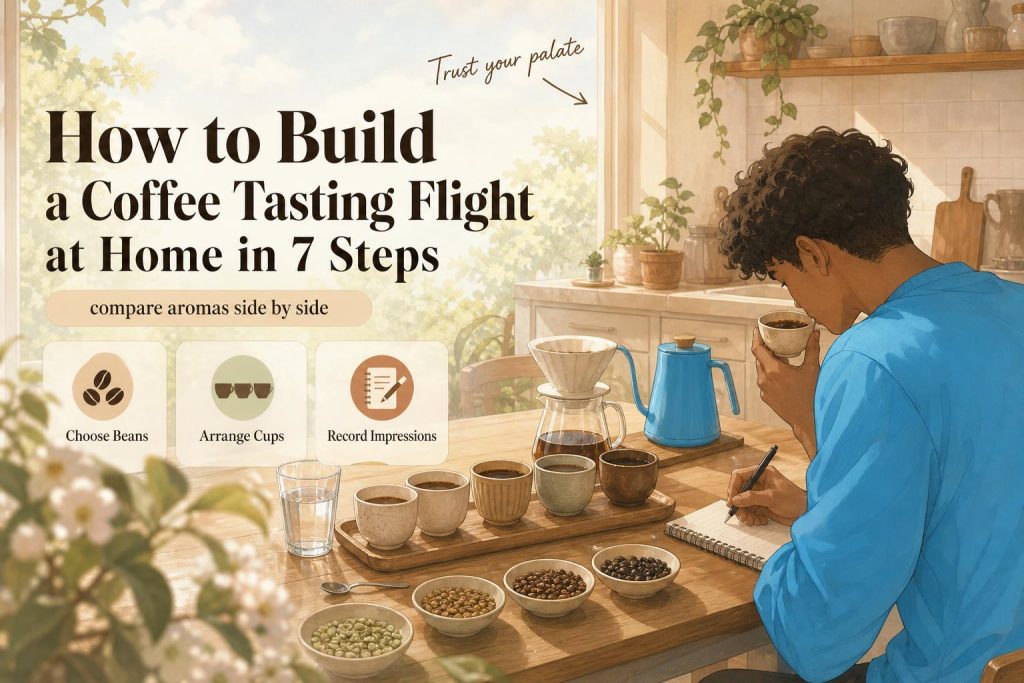
Three mugs, a kitchen scale, and a strip of masking tape marked A, B and C: that is most of the equipment you need. To build a coffee tasting flight at home, buy three coffees that differ in one clear way, brew them with the identical recipe, taste them blind from lightest to darkest, and write down what you notice next to what each bag cost. Plan on about 90 minutes from the first kettle boil to the final reveal. The difficulty is easy. If you can make a pour-over or run a drip machine, you can do this, and you will learn more about your own taste in one evening than you will from a dozen reviews.
The short version
A home coffee tasting flight is a side-by-side comparison of three coffees brewed under the same conditions. Choose a single variable to compare (origin, processing method, roast level, or brew method), keep the dose, grind, water temperature and brewer identical, and hide the labels until you have scored each cup. Taste delicate coffees before heavy ones. Record price per ounce and roast date with your flavor notes so the winner is also a smart buy.
Before you start: the checklist
- Three coffees, in 8–12 ounce bags or roaster sample packs
- A grinder (any kind) or pre-ground coffee from the same grind setting
- A kitchen scale that reads in grams
- One brewer you know well: pour-over cone, French press, AeroPress or drip machine
- Three identical mugs or glasses, plus a spoon and a water glass for rinsing
- Masking tape and a marker
- A copy of the tasting grid from Step 6, on paper or your phone
You do not need a cupping bowl, a gooseneck kettle, or a refractometer.
Step 1: Pick one thing to compare
Decide what the flight is about before you buy anything. I call this the one-variable rule. If your three coffees differ in origin, roast and process all at once, you cannot tell which change produced the flavor you liked. Hold everything else steady and the comparison teaches you something.
| Flight theme | What to buy | What you will notice | Best for |
|---|---|---|---|
| Three origins | Same roast level, e.g. Ethiopia, Colombia, Sumatra | Fruit vs. caramel vs. earthy | First flights |
| Three processes | Washed, natural, honey from one region | Clean vs. jammy vs. in-between | Second flight |
| Three roast levels | One bean at light, medium, dark | Acidity fading, bitterness rising | Dark-roast drinkers |
| One coffee, three ways | One bag; drip, espresso, cortado | Brew method changes everything | Groups who want variety |
The last format has a following. Enthusiasts on X describe tasting one bean as drip, espresso and cortado as more revealing than comparing three different bags, because it shows how much the brewer shapes the cup. Strictly, it breaks the one-variable rule on purpose: the variable is the method.
Tip: for your first flight, choose three origins at the same roast level. The differences are large enough that a beginner will hear them clearly.
Step 2: Buy three coffees in small amounts
Order three 8–12 ounce bags, or ask a local roaster whether they sell sample portions. Small bags limit waste and keep the evening under about $60 for most specialty roasters. Prices have eased a little, too: the Specialty Coffee Transaction Guide tracked a 2.5% year-over-year drop in specialty-coffee prices between Q4 2024 and Q4 2025.
When the bags arrive, write two numbers on each one: the roast date and the price per ounce. Divide the bag price by its weight in ounces. A $22 bag of 12 ounces costs about $1.83 an ounce, and a $19 bag of 8 ounces costs closer to $2.38. You will want those figures in Step 7.
Pitfall: brand-new coffee tastes muddled. One beginner on r/JamesHoffmann followed cupping instructions to the letter and came away disappointed, and coffee that had not rested is a common culprit. Give beans roughly a week off roast before the flight, and avoid bags without a roast date printed on them.
Step 3: Lock your recipe
Write down one recipe and use it for all three coffees. A reliable starting point is 15 grams of coffee to 250 grams of water just off the boil (around 200°F), at a medium grind, with the same brewer and the same timer. Grind each coffee fresh if you can. If you are using pre-ground, make sure all three bags were ground for the same brew method.
Consistency matters more than equipment. That said, if you plan to make flights a habit, spend money where the job is repeatability:
- Under $30: a basic kitchen scale and whatever grinder you own.
- Mid-tier: a burr grinder, which produces more even particles than a blade grinder.
- Premium: the Fellow Ode Brew Grinder Gen 2, listed at $399.95, and the Acaia Pearl scale at $150. Bought together that is roughly $550 before tax, shipping or a single bean.
Know the Ode's limits before buying. Fellow rates it for brewed coffee, not espresso, and its hopper holds 100 grams, which is enough for a three-coffee flight with room to spare. The Pearl reads to 0.1 gram, a precision competition baristas care about. For a home tasting, a scale that reads whole grams is fine.
Tip: brew the three coffees back to back, then let all three cool together for five minutes. Flavors open up as the coffee drops from scalding to warm, and staggered brewing means you taste each cup at a different temperature.
Step 4: Label the cups blind
Have someone else pour, or shuffle the cups yourself with your eyes closed, then tape A, B and C on the bottom or the side of each mug. Keep the key on a folded note. Blind tasting removes the expectation that the $28 Geisha must be better, or that the dark roast will taste burnt. If you are hosting, this is also the part that makes the evening fun.
Pitfall: identical mugs matter. A white ceramic cup next to a clear glass changes how people judge color and, oddly, sweetness. Use three of the same vessel.

Step 5: Taste in order, light to dark
Work through the coffees from the most delicate to the heaviest. Light, bright coffees go first because a dark roast's bitterness lingers and flattens whatever follows. If you are blind, the person holding the key should arrange the order.
For each cup, use this sequence:
- Smell the dry grounds before brewing, if you saved a pinch.
- Smell the brewed coffee.
- Take a sip and note acidity: does it taste bright, tart, or flat?
- Note sweetness.
- Note body: thin like tea, or round and syrupy?
- Note bitterness.
- Note the finish: what stays in your mouth ten seconds later?
Rinse with water between cups.
Use the words you already have. Citrus, chocolate, berry, floral, nutty, light-bodied, syrupy: these are enough. Plenty of people on r/pourover complain that tasting notes have become so elaborate (specific plum varieties, named acid types) that they stop being useful. If coffee A reminds you of orange peel and coffee B of cocoa, you have tasted the difference. You do not need to name the cultivar of the orange.
Step 6: Record the numbers along with the flavors
Copy this grid for each coffee:
| Field | A | B | C |
|---|---|---|---|
| Aroma | |||
| Acidity (1–5) | |||
| Sweetness (1–5) | |||
| Body (1–5) | |||
| Bitterness (1–5) | |||
| Finish | |||
| Three words | |||
| Would I buy it? |
After the reveal, add origin, variety, processing method, roast date and price per ounce.
The origin column is where the flight becomes more than a taste test. Coffee supports roughly 12.5 million farming families, so comparing Ethiopia to Colombia is also comparing two very different farming economies. The market behind your three bags is shifting. In the International Coffee Organization's January 2026 Coffee Market Report, Arabica made up 64.1% of green-coffee exports in the first three months of coffee year 2025/26, down from 67.4% a year earlier, which means robusta is taking a larger share of what ships.
Ethics are changing on a schedule too. Fairtrade International announced on July 30, 2026 that it will raise the Fairtrade Minimum Price for coffee, but the increase applies only to contracts signed on or after December 1, 2026. A certified bag you buy this fall almost certainly predates it. Fair Trade USA runs a separate certification, so check which label your bag carries.
Step 7: Reveal, rank and buy again
Uncover the labels, then rank the coffees twice: once by flavor, once by flavor per dollar. The second ranking is the useful one. A coffee you scored a 4 at $1.80 an ounce often beats a 4.5 at $3.10, especially for a daily cup.
Then buy a full bag of the winner. Keep the grid. Your next flight should change one thing about the winner, such as the same farm with a different process, so each flight builds on the last instead of starting over.
Troubleshooting
Why do all three coffees taste the same?
Your coffees were probably too similar, usually three medium roasts from Central America. Pick origins from different continents next time, or try the roast-level flight.
Why is everything sour?
Sourness at every cup usually means under-extraction: a grind that is too coarse or water that is too cool. Grind one step finer and use water closer to boiling for all three.
Why is everything bitter?
The opposite problem, over-extraction, or you tasted dark coffee first and it coated your palate. Grind coarser, shorten the brew, and keep the light-to-dark order.
Why can't I name any flavors?
That is normal for a first flight. Ignore flavor names and answer three questions instead: which was brightest, which was heaviest, and which would you drink again. Those answers are the result.
Tip: Running a flight for friends? Pour each cup only a third full. People taste more carefully from small pours, and you can brew the whole flight from one batch per coffee.
Where to find a coffee flight outside your kitchen
Interest is there. The National Coffee Association and Specialty Coffee Association's 2026 report, drawn from a January 2026 survey of 1,850 U.S. adults, found that 47% of Americans had a specialty coffee in the past day. That was five points ahead of traditional coffee at 42%, while two-thirds of adults had coffee of any kind. Among 25-to-39-year-olds, 69% had specialty coffee in the previous week, the highest share of any age group.
That demand shows up on cafe menus. In Los Angeles, Atlanta and San Diego, flights appear at specialty shops and roastery tasting rooms, but menus rotate seasonally, so call ahead or check the shop's recent posts before you go. Many cafe flights are latte flights or iced coffee flights built around syrups and milk, which are fun but teach you about flavorings more than beans. Ask for a single-origin or brew-method flight if you want the comparison this guide covers. Traveling? Roastery tasting rooms are a good way to anchor a food stop, the same instinct behind our guide to the top spots to have a bite in Montreal, and our tips on how to fly like a pro cover packing beans in a carry-on.
Next steps
Run a second flight within two weeks while your notes are fresh. Change one variable from the first: if origins were your theme, try three processes from your favorite origin. If you want a group format, the brew-method flight works well alongside other at-home hangouts like the ones in 6 must-try very American activities. Bring your grid to the roaster and ask what they would pour next.
Frequently asked questions
What is a coffee tasting flight?
A coffee tasting flight is a set of small cups, usually three, tasted side by side so you can compare them directly. The coffees differ in one way, such as origin, roast level or processing method, while the brewing stays identical. Cafes serve flights on their menus, and you can build one at home with three bags of coffee, a scale and three matching mugs.
How much coffee do I need for a home tasting flight?
You need about 15 grams of each coffee per cup, so a single 8–12 ounce bag of each covers the flight several times over. Small bags or roaster sample packs keep costs and waste down. If you are serving a group, brew one larger batch per coffee and pour small portions rather than brewing each cup separately.
Can I make an iced coffee tasting flight at home?
Yes. Brew all three coffees with the same recipe, then cool them the same way: either chill them in the fridge for an hour or brew them as cold brew for the same number of hours. Taste them at the same temperature. Cold mutes acidity and aroma, so expect smaller differences than a hot flight and choose very different coffees.
Do I need an expensive grinder for a coffee flight?
No. Consistency matters more than equipment. A blade grinder or pre-ground coffee from the same grind setting works for a first flight. A burr grinder such as the Fellow Ode Gen 2, listed at $399.95, gives more even results, but it is an upgrade for repeat tasters, not a requirement.
What drinks can go in a coffee flight?
Almost any coffee drink can, as long as the flight has a clear theme. Common options are three single-origin pour-overs, one bean as drip, espresso and cortado, latte flights with different milks or syrups, and iced coffee flights. Bean-focused flights teach you the most about what you like to buy.
Should I taste coffee flights blind?
Yes, if you can. Label cups A, B and C and keep the key hidden until everyone has scored. Blind tasting stops price, origin or roast expectations from shaping your opinion, and it often reveals that a cheaper coffee is your favorite.
Related Reading
- How to Find Unique Travel Destinations Beyond the Usual Tourist Routes
- How to Choose a Luxury Destination Without Overspending
- 11 Pricing Strategy Tips That Actually Work for Small Brands
- Luxury Train Journey vs Yacht Charter: Which Feels More Exclusive?
- 11 Business Planning Tips That Actually Work for Creators
- 13 E-Commerce Tips That Actually Work for Collectibles Sellers
- 10 Best Lifestyle Magazines Covering Travel, Food, and Fashion
- 12 Best Travel Gadgets for Frequent Flyers
- Boost Your Productivity With All-in-One Computers: Must-Have Features
- Contact IoC