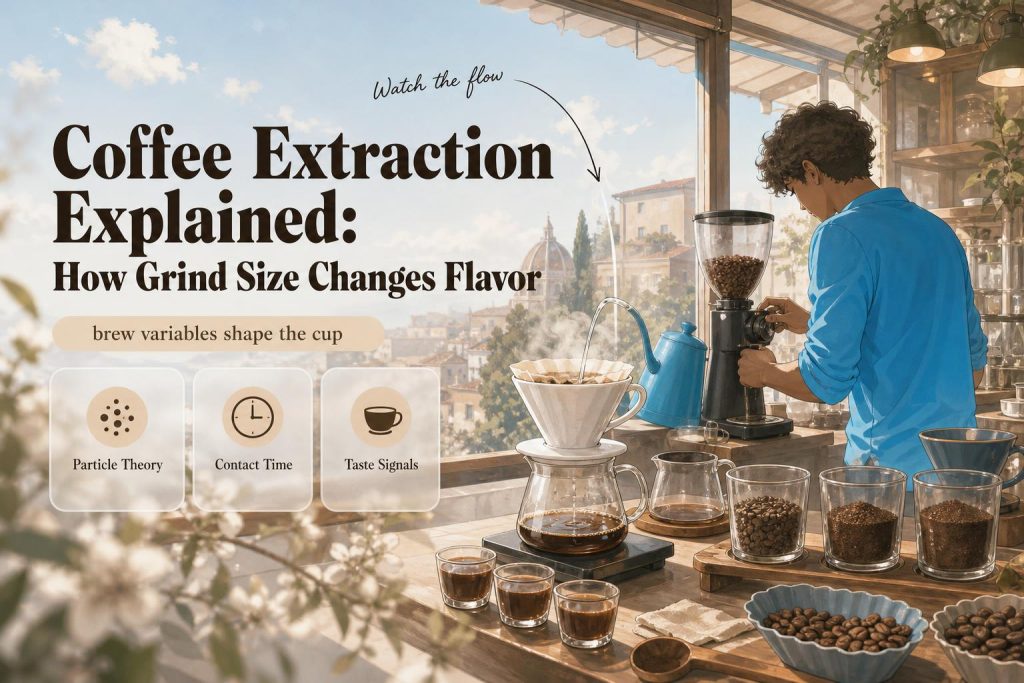
You change one click on the grinder and nothing else, and tomorrow's cup tastes like a different coffee: yesterday's was thin and sharp, today's is round and sweet. That click changed the coffee extraction. Coffee extraction is the process of hot (or cold) water dissolving soluble compounds out of ground coffee. Grind size is the strongest lever you have over it because it controls two things at once: how much surface area the water can reach, and how fast the water moves through the grounds.
The short version
Finer grounds expose more surface area and usually extract faster. Coarser grounds extract more slowly. That rule stops working at the extremes. Grounds that are too fine slow the flow, clog filters and push water into channels, so parts of the coffee bed over-extract while other parts barely extract at all. Diagnose by taste. Go finer when the cup is sour or thin, go coarser when it is bitter, drying or slow, and change only one variable at a time.
How coffee extraction works
Roasted coffee is a woody cell structure holding a mix of soluble material: acids (including chlorogenic acids), caffeine, sugars, browning products from roasting, and bitter compounds. Water dissolves these at different speeds. Bright acids and caffeine come out early. Sweetness and body arrive in the middle. The heavier, harsher compounds come last. Balanced coffee is a brew stopped at the right point in that sequence.
Grinding sets the pace in four steps:
- Grinding breaks beans into particles. Smaller particles have more surface exposed and a shorter path from the particle's center to the water.
- Water wets the grounds and starts dissolving soluble material, fastest at the surface.
- In filter and espresso brewing, the packed grounds form a bed that resists flow. Finer grounds pack tighter and slow the water down, which lengthens contact time.
- Brewing stops when the water drains (pour-over, espresso) or when you separate liquid from grounds (French press, cold brew).
Extraction is measured as extraction yield: the percentage of the dry coffee's weight that ended up dissolved in your cup. The Specialty Coffee Association's long-standing target is 18–22%, a definition cited in a 2026 ultrasound-extraction study in the Journal of Food Engineering. Read it as a reference band. It will not guarantee a good cup. On r/pourover, brewers regularly point out that yields above the band can taste excellent if the cup stays balanced, and the number tells you nothing about whether the beans were good in the first place.

Why does grind size change flavor so much?
Grind size changes flavor because it decides which compounds reach your cup and in what proportion. Too coarse for the method, and water leaves before sweetness dissolves, so you taste sharpness and thin body. Too fine, and the brew keeps going into bitter, drying territory. The middle setting is where sweetness and body show up.
The sensory map is consistent enough to work from:
- Under-extracted: sour, sharp, salty, thin, short finish.
- Balanced: sweet, clear acidity, full body, a finish that lingers pleasantly.
- Over-extracted: bitter, hollow, astringent (that dry, puckering feeling on your tongue), sometimes muddy.
Grind also shapes specific flavor compounds. A 2026 filter-coffee study in the Journal of Research in Pharmaceutical and Food Sciences found roast-associated pyrazines, the nutty, toasty aromatics, most abundant in the medium-fine particle fraction. So a grind setting adjusts how much you extract and also tilts which flavors dominate the cup.
None of this works in isolation. Water temperature, brew time, dose, ratio, agitation, roast level, bean freshness and water chemistry all move extraction too. Hotter water extracts faster, which is why the SCA's familiar pour-over range sits around 90–96°C (195–205°F). Lighter roasts are denser and harder to extract, so they usually want a finer grind or hotter water than dark roasts.
Why can a cup taste sour and bitter at once?
This is the caveat most guides skip. I call it the split cup: a brew that is under-extracted and over-extracted at the same time, because water found an easy path through the coffee bed. The grounds along that channel get stripped bare, the grounds beside it barely get wet, and you taste sourness and bitterness in the same sip.
Excessive fineness is the usual cause. It explains why "finer always extracts more" is only half true. Below a critical particle size, fines block flow and push water into channels, and total extraction can drop as you grind finer. Ask an espresso machine for more than it can push and you will get a split cup, not more flavor.
That is also why beginners on r/IndiaCoffee often ask whether a fast shot means something is wrong. Usually it does, and the answer is more complicated than "grind finer." A shot that gushes in 12 seconds is under-extracted. A shot that drips for 45 seconds and still tastes sour is channeling. The fix for the second is better puck preparation and even distribution, sometimes with a coarser grind, not another click finer.
Warning: If your coffee tastes sour and bitter at the same time, do not grind finer. Check for channeling first: uneven distribution in the basket, a lopsided pour-over bed, or grounds packed so fine the water cannot pass evenly. Correct the flow before you touch the grind setting.
Some bitterness is not an extraction problem at all. Home brewers on r/IndiaCoffee report trouble telling extraction bitterness apart from roast character. A dark roast tastes smoky and roasty at any grind. If going coarser makes the cup weak and it is still burnt, the fix is a different bag of beans.
A worked example: dialing in a pour-over
Here is the feedback loop in practice. Taste, name the symptom, change one variable, brew again.
Start with 15 g of coffee and 250 g of water at 94°C. You drain about 220 g of coffee, because the grounds hold some water back. A refractometer reads 1.35% total dissolved solids (TDS).
- Dissolved coffee in the cup: 220 g × 0.0135 = 2.97 g
- Extraction yield: 2.97 g ÷ 15 g = 19.8%
That sits inside the SCA band, but the cup tastes thin and a little sharp, and it drained in 2:15. Both point to under-extraction. Go one or two steps finer and change nothing else. The next brew drains in 3:05, the refractometer reads 1.45%, and yield climbs to about 21.3% (220 × 0.0145 ÷ 15). The cup is sweeter and heavier. Stop there.
Most people will never buy a refractometer, and they do not need one. Drawdown time and taste carry most of the information. Newcomers on X often ask whether the small steps matter (rinsing the paper filter, preheating the brewer, a 30-second bloom to prewet the grounds). They do, because each one removes a variable that would otherwise confuse what your grind change did.

Grind starting points by brew method
Grinder numbers do not transfer between brands. A "12" on one grinder has nothing to do with a "12" on another. Use these as descriptions, then dial in by taste.
| Method | Grind | Typical contact time | If sour or thin | If bitter or drying |
|---|---|---|---|---|
| Espresso | Fine | About 25–30 seconds | Finer, or a longer shot | Coarser, check for channeling |
| Moka pot | Fine to medium-fine | 3–5 minutes on heat | Finer, if the pot still flows | Coarser, lower heat |
| Pour-over | Medium-fine to medium | About 2:30–4:00 | Finer, or more agitation | Coarser, gentler pour |
| Automatic drip | Medium | About 4–6 minutes | Finer | Coarser |
| French press | Coarse | About 4 minutes | Longer steep, slightly finer | Shorter steep, coarser |
| Cold brew | Coarse to extra-coarse | 12–24 hours | Longer steep | Shorter steep, coarser |
The moka pot row has a twist. Users on r/mokapot report their best results come from grinding as fine as their pot will tolerate without choking. The useful grind range is set by the method, the equipment and the recipe together.
Does your grinder matter more than your brewer?
Yes, and I would spend money on a grinder before a fancy kettle or brewer. The reason is particle-size distribution, the hidden variable behind the grind setting. Every grinder makes a spread of sizes: some fines, some boulders, and a cluster in the middle. Two grinders set to "medium" can produce different cups because one makes more fines or more boulders. A tighter spread means the bed extracts more evenly and split cups happen less often.
Mistakes cost more now. Arabica futures hit roughly $4.41 per pound in early 2025, according to Coffee Intelligence, and a bag ruined by a bad grind is a more expensive loss than it was a few years ago. Coffee is also a daily habit for a lot of people: two in three Americans said they had coffee the previous day in the SCA's 2025 National Coffee Data Trends report.
For a concrete example of adjustment precision, the Baratza Encore ESP is built with finer espresso-range steps, and its U.S. product page listed it at $199.95 (and out of stock) in October 2026. Fine adjustment gives you the ability to make small changes. It cannot dial in the cup for you. If you are planning a home coffee corner, kitchen layout matters more than you'd think, even for a grinder and a kettle.
Tip: Change one variable per brew and write it down. If you change grind and ratio together and the cup improves, you will not know which change did it.
Related concepts
- Total dissolved solids (TDS): the concentration of dissolved coffee in the liquid, which is how strong it tastes, measured with a refractometer.
- Brew ratio: grams of coffee to grams of water, such as 1:16 for pour-over or 1:2 for espresso.
- Channeling: water taking a preferred path through the coffee bed, which causes split-cup flavor.
- Fines: very small particles that extract fast and can clog filters.
- Immersion vs. percolation: grounds steeping in water (French press) versus water passing through a bed (pour-over, espresso).
- Ultrasound-assisted extraction: an experimental method. One 2026 study reached espresso-strength drinks in about two to three minutes, with extraction comparable to traditional espresso. That research shows grind interacting with energy input, ratio and time rather than acting alone.
Extraction is the same chemistry behind fruit and vegetable concentrates: solvent, surface area, time. In coffee, you also have to taste the result and correct it on the next brew.
Frequently asked questions
What is coffee extraction in simple terms?
Coffee extraction is water dissolving flavor compounds out of ground coffee. Acids and caffeine dissolve first, sugars and body come next, and bitter compounds arrive last. A good cup stops the process at the point where sweetness and acidity are in balance. The SCA's reference range for extraction yield is 18–22% of the coffee's dry weight. That range is a guide, not a guarantee.
How do I know if my coffee is under-extracted or over-extracted?
Taste it. Under-extracted coffee is sour, sharp, thin or salty with a short finish. Over-extracted coffee is bitter, hollow or drying. If you taste sour and bitter together, the problem is probably uneven extraction caused by channeling, not one simple error. Flow time helps too: a fast drawdown or shot usually points to under-extraction.
How do I fix sour, under-extracted coffee?
Grind slightly finer first. If that does not help, extend contact time, add a little agitation, or raise water temperature toward the top of the 90–96°C range. Make one change per brew. Very light roasts may need several small steps finer before they taste sweet.
What is the ideal extraction time for coffee?
It depends on the method. Common starting points are about 25–30 seconds for espresso, 2:30 to 4:00 for pour-over, around four minutes for French press, and 12–24 hours for cold brew. Treat these as starting ranges and adjust by taste.
Can two grinders on the same setting make different coffee?
Yes. Grinder numbers are not standardized across brands, and each grinder produces its own particle-size distribution. One machine may make more fines or boulders than another at a similar setting, which changes flow and how evenly the coffee extracts. Dial in each grinder by taste rather than copying someone else's number.
Related Reading
- How to Build a Coffee Tasting Flight at Home in 7 Steps
- Coffee Subscription vs Local Roaster: Which Offers Better Freshness?
- 11 Pricing Strategy Tips That Actually Work for Small Brands
- 13 E-Commerce Tips That Actually Work for Collectibles Sellers
- 11 Business Planning Tips That Actually Work for Creators
- 9 Tech Gadget Buying Mistakes to Avoid
- How to Choose Software for a Growing Lifestyle Publication (Step-by-Step)
- How to Find Unique Travel Destinations Beyond the Usual Tourist Routes
- Boost Your Productivity With All-in-One Computers: Must-Have Features
- Contact IoC