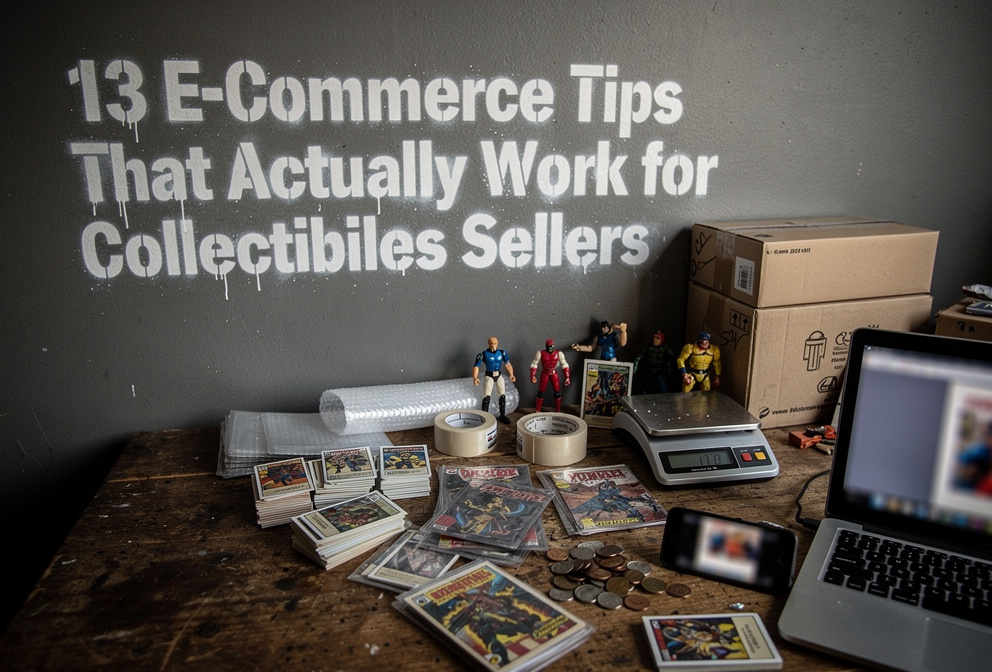
Collectibles selling online rewards operators who treat authenticity as a selling point, price against sold comparables (not asking prices), and match each item to the right channel. The three tips that move the needle most: verify demand with sell-through data before you source, photograph and disclose condition like a listing feature, and run a multichannel model with eBay for search demand and Whatnot for live community sales. eBay was chosen by 65% of collectors in the Deloitte Access Economics Collector Survey (2025), while Whatnot reported more than $6 billion in sales during 2025.
This guide is written for sellers, not shoppers. Every tip below connects to sourcing, conversion, operational efficiency, risk reduction, or profit after every fee.
The 13 tips at a glance
- Pick a narrow niche you can authenticate
- Validate demand with sold comparables, not search rankings
- Buy at a disciplined percentage of market value
- Treat authenticity and condition as merchandising
- Shoot a consistent, glare-controlled photo set
- Keep a unique-item inventory record
- Calculate profit after every fee before you list
- Choose channels by demand type, not habit
- Match the right eBay Store tier to your volume
- Run live selling as scheduled programming
- Use AI for listing speed, humans for final judgment
- Plan for shipping risk and cross-border logistics
- Build repeat-purchase systems, not one-off sales
How these tips were selected
Selection criteria reflect what actually changes a collectibles seller's results: measurable demand signals, real fee structures, condition disclosure that converts, and inventory discipline over long holding periods. Each tip cites platform-reported figures or survey data where available. Channel recommendations are matched to the kind of demand they generate rather than ranked as universally "best."
| # | Tip | Best for | Standout point |
|---|---|---|---|
| 1 | Niche focus | Spotting fakes and variants | Recognize grading differences |
| 2 | Sold comps | Pricing and sourcing | Sold beats asking prices |
| 3 | Acquisition discipline | Buying collections | Buy at 70-80% of market |
| 4 | Condition merchandising | Conversion | 12% of buyers weigh authenticity |
| 5 | Photo set | Trust and returns | Front, back, corners, cert |
| 6 | Unique-item records | Long holds | Track cert, cost, min price |
| 7 | Profit formula | Avoiding losses | Subtract every fee |
| 8 | Channel choice | Reach | eBay + Whatnot + store |
| 9 | eBay Store tier | Fee control | From $4.95/mo |
| 10 | Live selling | Community sales | 80 min daily engagement |
| 11 | AI tools | Listing speed | 30M+ card scans |
| 12 | Shipping risk | Cross-border | Tariffs and logistics |
| 13 | Repeat systems | Lifetime value | Drops and saved searches |
1. Pick a narrow niche you can authenticate
Focus on one category deep enough to recognize variants, counterfeits, grading differences, and realistic prices. A seller who knows Pokémon cards, vintage LEGO, sports memorabilia, coins, comics, or designer toys spots a reprint, a trimmed edge, or a restored figure that a generalist misses.
Depth protects margin. The 2025 eBay Collected Report listed Pokémon, LEGO Star Wars, Hot Wheels, and Michael Jordan among the top searches from January through October 2025. Knowing which parallels and grades within those categories actually sell is what separates a profit from a stall.
Verdict: niche knowledge is your fraud filter and your pricing edge. Start narrow, widen later.
2. Validate demand with sold comparables, not search rankings
Sold comparables beat asking prices for setting inventory value, purchasing collections, and estimating profit. Search rankings show interest; sold listings show what buyers paid. Treat them as separate data.
eBay search rankings can guide sourcing, but validate each item with sell-through rate, median sold price, active competition, shipping risk, and grading cost. A card that trends in searches but has 40 unsold listings against three recent sales is a demand mirage.
Tip: Before buying inventory, pull the last 10 sold comps for the exact card, set, parallel, and grade. Two listings with identical names can differ in value by hundreds of dollars based on condition alone.
Verdict: proof of demand is a sale that closed, not a keyword that ranks.
3. Buy at a disciplined percentage of market value
Sellers on r/PokeInvesting debate whether buying collections at 70% to 80% of market value leaves enough room to profit after fees, shipping, and other costs. The answer depends on your fee stack, so set an offer ceiling before you negotiate.
Work backward from realized profit. If eBay takes roughly 13.6% in final-value fees plus a per-order charge, shipping runs a few dollars, and grading costs more, an 80% acquisition price can erase your margin on lower-value items. Volume and speed can justify thinner margins; single high-value pieces usually cannot.
Verdict: your offer limit is a math output, not a gut feeling.
4. Treat authenticity and condition as merchandising
Authenticity certificates and buyer protection each accounted for 12% of marketplace-selection factors in the Deloitte Access Economics Collector Survey (2025). Display grades, certification numbers, edition, restoration history, and flaws prominently in the listing itself, not buried in fine print.
A complete condition record states grading company and grade, certification number, edition or variant, restoration history, visible flaws, missing accessories, packaging condition, and provenance where relevant. Buyers who can verify a cert number in the title convert faster and dispute less.
Verdict: disclosure that reads as confidence sells. Hidden flaws generate returns and negative feedback.
5. Shoot a consistent, glare-controlled photo set
A reliable photo set shows the front, back, corners and edges, serial or certification details, flaws, packaging, and a scale reference when useful. Consistency across your catalog signals a professional seller and reduces "not as described" claims.
Different categories need different setups. Cards and coins require glare-controlled lighting so buyers can read surface condition. Toys and figures should show articulation, paint wear, included accessories, and factory seals. New sellers on r/Ebay frequently ask exactly which photos buyers expect for pins, figures, and giveaway memorabilia: the answer is every angle that could hide a defect.
Verdict: photograph the flaw before a buyer finds it. The photo set is your return-rate insurance.
6. Keep a unique-item inventory record
Track each item individually, not as a generic SKU count, because two items with the same product name may differ in grade, defects, accessories, packaging, or certification. A practical record holds acquisition cost, acquisition date, source, condition details, certification number, storage location, listing channels, asking price, minimum acceptable price, and realized profit after fees and shipping.
Long holding periods make this record essential. Collectible inventory can sit unsold for months. Storage location tracking, periodic condition rechecks, insurance review, and scheduled repricing keep a stalled item from quietly losing value.
Verdict: the seller who knows their minimum acceptable price on every item negotiates from strength.

7. Calculate profit after every fee before you list
Subtract marketplace fees, payment fees, shipping, packaging, authentication or grading, advertising, and cost of goods from the sale price. An apparently profitable sale turns into a loss when you count all seven.
Work an example. Sell a $60 card on eBay: a 13.25% trading-card final-value fee is roughly $7.95, plus a $0.40 per-order fee, plus $4 shipping, plus $1 packaging. Add a $25 grading cost and a $30 acquisition price and the sale nets a loss before you count listing time. Run this before sourcing, not after selling.
Warning: Grading and authentication costs are easy to forget in profit math. On sub-$100 items, grading can cost more than the margin it adds. Confirm the graded comp premium exists before you pay for the slab.
Verdict: price to net profit, not to headline sale price.
8. Choose channels by demand type, not habit
Run a multichannel model matched to how each platform generates demand. Use eBay for search-driven buyers, Whatnot for live community selling, Etsy only where inventory qualifies, and an independent store for brand ownership and repeat purchases.
The Deloitte Access Economics Collector Survey (2025) found 61% of collectors buy through online marketplaces and 70% sell through them, so marketplace presence is where most transactions happen. eBay was selected by 65% of respondents, the most of any marketplace.
Etsy fits qualifying vintage goods, handmade items, craft supplies, and customized pieces. Etsy charges a $0.20 listing fee per item (whether or not it sells), listings expire after four months, and a 6.5% transaction fee applies to the displayed price plus shipping, per Etsy's fee policy. Verify your collectibles comply with Etsy's rules before listing there. For readers weighing broader market visibility, see how to make trade shows worth your time.
Verdict: one channel caps your reach. Match inventory to the platform that sells it.
9. Match the right eBay Store tier to your volume

eBay Store tiers change your listing allowance and can lower category final-value fees, so pick the tier your volume justifies. Individual sellers get up to 250 zero-insertion-fee listings per month, with additional listings generally $0.35 each as of 2026.
Here are the annual-subscription store rates as of 2026, per eBay's seller center:
| Store tier | Monthly price | Fixed-price listings included |
|---|---|---|
| Starter | $4.95 | 250 |
| Basic | $21.95 | 1,000 (+250 auction) |
| Premium | $59.95 | 10,000 (+500 auction) |
| Anchor | $299.95 | 25,000 (+1,000 auction) |
| Enterprise | $2,999.95 | 100,000 (+2,500 auction) |
Fee discounts can pay for the subscription. eBay's published examples show a 13.6% final-value fee in most categories up to $7,500 and 13.25% for trading cards, but an antiques example drops to 12.7% for Basic Store subscribers. On steady volume, the discount can exceed the $21.95 monthly cost.
Verdict: Starter suits testing; upgrade only when fee savings or listing caps demand it.
10. Run live selling as scheduled programming

Structure live shows like programming, not improvised streams: publish schedules, lot numbers, opening prices, and explicit shipping rules. Whatnot suits live auctions, card breaks, condition comparisons, and time-limited promotions.
The numbers behind live selling are large. Whatnot reported more than $6 billion in sales during 2025, more than double the prior year, with average buyer engagement near 80 minutes per day and more than 5 million listings created daily. During Black Friday, sellers' live sales rose 185% while traditional e-commerce grew 9%, per Whatnot's 2026 seller update. The number of Whatnot sellers earning at least $10,000 per month more than doubled in 2025.
eBay is expanding live too: eBay Live reached France, Italy, and Canada in Q1 2026.
Verdict: live selling rewards preparation. Announce the drop, number the lots, state the shipping.
11. Use AI for listing speed, humans for final judgment
Use AI to accelerate repetitive listing and research work, but keep authenticity, condition, edition, grading, and comparable-sales calls with a human specialist. eBay's card-scanning feature identifies cards from photos and surfaces historical pricing and population data.
The tool has scale: eBay reported its card-scanning feature surpassed 30 million cumulative scans by Q1 2026. Even so, verify the exact card, set, parallel, condition, grade, and comparable sales yourself. A scan that misreads a parallel or overlooks a crease can cost you the difference between a raw and graded price.
Verdict: let AI draft; let a specialist confirm what money depends on.
12. Plan for shipping risk and cross-border logistics
Build shipping cost, packaging, insurance, and cross-border rules into your profit math and your listing terms. Sellers on r/FlippingInCanada raise recurring concerns about shipping options, tariffs, and logistics when selling action figures and other collectibles internationally.
Fragile and high-value items carry real loss risk. Rigid packaging, tracked and insured services, and clear buyer instructions on customs and duties reduce disputes. A seller of retro football jerseys on r/ecommerce101 noted that quality and local competition matter, then asked how to grow demand beyond a small domestic market: cross-border shipping is often the growth lever, but only if the logistics math holds.
Verdict: quote shipping accurately or watch it eat your margin one parcel at a time.
13. Build repeat-purchase systems, not one-off sales
Turn buyers into repeat customers with new-drop alerts, saved searches, back-in-stock notifications, segmented email, bundles, and early access. The Deloitte survey found 84% of collectors buy at least twice a year and half buy six or more times, so repeat demand exists to capture.
Themed drops make promotion coherent. A 1990s Pokémon holo week, an authenticated signed-memorabilia release, or an under-$50 starter collection gives email, social, and live-shopping campaigns a reason to exist rather than random daily listings. An independent store, which lets you control branding and customer data, is where this repeat relationship compounds.
Publishing and merchandising your point of view matters here. Theindustryofcool covers travel, food, tech, and gadgets for curious readers and shoppers, and the same principle applies to sellers: a clear editorial angle on your niche builds the audience that buys again. For growth tactics beyond marketplaces, see 4 tips for expanding your customer base.
Verdict: the first sale is acquisition cost. Profit lives in the second, third, and fourth.
Other options considered
Several established outlets cover collectibles from a buyer's angle. InsideHook frames items through culture and discovery; GQ leans on status and premium positioning; Gear Patrol runs structured testing and comparison tables. Those approaches help shoppers decide what to buy. This guide covers the seller's side instead: sourcing, sold comps, authentication, inventory control, and profit after every fee.
If your inventory is handmade, vintage, or customized rather than graded cards or slabbed coins, Etsy is often the better first channel than a general marketplace. If your strength is presenting condition and answering questions in real time, Whatnot's live format will out-convert static listings.
Frequently asked questions
What are the most important collectibles ecommerce tips for a new seller?
Start with three: pick a narrow niche you can authenticate, price against sold comparables instead of asking prices, and calculate profit after every fee before you list. Beyond that, photograph condition consistently, keep a unique-item inventory record, and match each item to the channel that sells it best. New sellers lose money most often by skipping the profit math and by buying collections at too high a percentage of market value.
Which platform is best for selling collectibles?
It depends on demand type. eBay captures search-driven buyers and was chosen by 65% of collectors in the Deloitte Access Economics Collector Survey (2025). Whatnot suits live community selling and reported more than $6 billion in sales during 2025. Etsy fits qualifying vintage, handmade, or customized items. Most serious sellers run several channels and add an independent store for repeat customers and brand control.
How much does it cost to sell on eBay in 2026?
Individual sellers get up to 250 zero-insertion-fee listings monthly, with extra listings generally $0.35 each. Final-value fees generally range from 2.5% to 15.3% by category, plus a per-order fee of $0.30 (orders $10 or under) or $0.40 (over $10). Published 2026 examples show 13.6% in most categories and 13.25% for trading cards up to $7,500. eBay Store subscriptions run from $4.95 to $2,999.95 per month.
How do I price collectibles accurately?
Use sold comparables, not asking prices. Pull the last several closed sales for the exact card, set, parallel, edition, and grade, then check sell-through rate and competition. Asking prices show what sellers hope for; sold prices show what buyers actually paid. Verify AI-suggested values by hand, since a misread parallel or overlooked flaw can swing value significantly.
How do I make a profit when buying a collection?
Set an offer ceiling by working backward from realized profit. Subtract marketplace fees, payment fees, shipping, packaging, grading, advertising, and your other costs from expected sale prices, then buy below that number. Sellers on r/PokeInvesting note that even 70% to 80% of market value can erase margin on lower-value items once every fee is counted. Discipline on the buy price protects the sell-side profit.
Is live selling worth it for collectibles?
For sellers who can present condition and answer questions in real time, yes. Whatnot reported average buyer engagement near 80 minutes per day, and sellers' Black Friday live sales rose 185% in a year while traditional e-commerce grew 9%. Live selling works best as scheduled programming with lot numbers, opening prices, and clear shipping rules, not as an improvised stream.
Related Reading
- 11 Pricing Strategy Tips That Actually Work for Small Brands
- 11 Business Planning Tips That Actually Work for Creators
- Top 9 Business Models Powering the Creator Economy
- 14 Best Accounting Software Options for Lifestyle Businesses
- Tech Accessories Statistics 2026: 40 Numbers That Matter
- How to Find Unique Travel Destinations Beyond the Usual Tourist Routes
- Top 8 Tech Accessories for a More Productive Desk
- 35+ Eye-Opening Smart Home Gadget Stats (2026)
- Boost Your Productivity With All-in-One Computers: Must-Have Features
- Does Your Home Need Revamping?