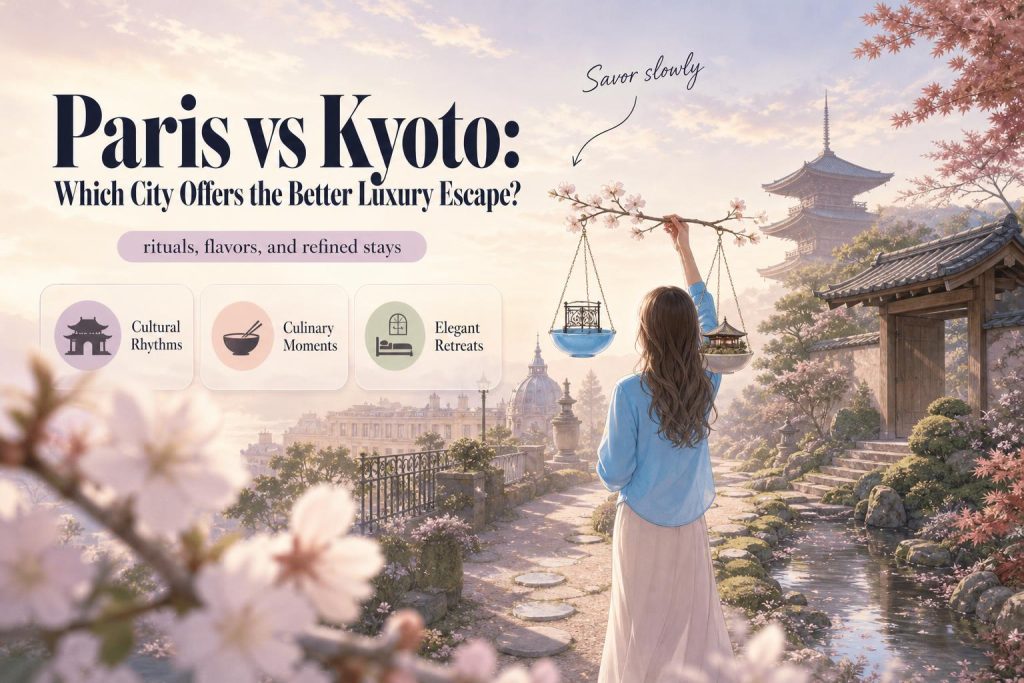
You can feel the difference between these two cities in the first hour. In Paris, you drop your bags at a palace hotel on the Right Bank and you are ten minutes on foot from a Dior flagship, a two-star lunch and a Caravaggio. In Kyoto, the first hour is quieter: a tea-ceremony slot booked weeks ahead, a garden you see only because someone arranged it, a kaiseki dinner that starts when the chef is ready. So which is the better luxury escape? For a first serious luxury city break, Paris wins: it puts more of the good things closer together than almost anywhere. If you have already done Paris properly, Kyoto is the better escape, and the gap is wide.
That is our position. The rest of this piece argues it with prices, tax rules and visitor figures, because luxury travel is where vague advice costs the most.
The short version
Paris is the better all-round luxury city break: palace hotels, fashion houses, haute joaillerie, Michelin dining, museums and nightlife sit inside a compact, well-connected city. Kyoto is the more distinctive luxury retreat, built on privacy, gardens, temples, ryokan hospitality and seasonal ritual. Choose Paris for variety and convenience on a first trip; choose Kyoto for calm, depth and a stronger sense of exclusivity.
Paris sells density, Kyoto sells appointments
The clearest way to understand the two cities is what we call density luxury versus appointment luxury. Paris is density luxury. Its pleasures are open, adjacent and stackable, so a single afternoon can hold a museum, a fitting, a long lunch and an aperitif without a single taxi longer than fifteen minutes. A Paris Museum Pass costs €85 for 48 hours, €105 for four days or €125 for six, with the clock starting at first use, and the city rewards the traveler who wants to see a great deal in a short time.
Kyoto runs on appointments. The best experiences are scheduled, small and tied to a specific place: a private temple viewing, a session with a lacquer artisan, a meal at a counter with eight seats. You build the day around three or four fixed points and leave room between them. Travelers on r/travel describe the city as calmer and more atmospheric than Tokyo or Osaka, with the mood of the place becoming part of the luxury itself. That matches what we hear from readers: in Kyoto the setting does as much work as the service.
The practical consequence is pacing. A Paris itinerary can be dense and still feel indulgent. A Kyoto itinerary packed the same way feels like a checklist, and you lose the thing you came for. Plan two anchors a day in Kyoto, maximum, and protect your early mornings for the temples before the tour groups arrive.
Getting around reflects the same split. In Paris, a Paris Visite pass covering all zones, airports included, runs €30.60 for one day up to €78 for five, according to Île-de-France Mobilités. Kyoto's adult subway-and-bus day pass costs ¥1,100 (¥550 for children), and a subway-only pass is ¥800. Both are cheap. Neither matters much at this budget, because in Kyoto most luxury travelers end up in private cars to reach those appointments on time.
What a four-night stay costs a couple
Headline room rates are where both cities mislead you, so it helps to work one real scenario.
Take a couple spending four peak-season midweek nights in Paris at the Four Seasons Hotel George V. A 2026 market benchmark published by Business Class Journal put a Superior Room there at roughly €3,400 a night in that window, against about €2,250 in low season and €4,200 on a peak weekend. Four midweek nights comes to around €13,600 for the room. Add two four-day museum passes (€210) and two five-day all-zone transport passes (€156, which also covers the airport run), and you are near €13,970 before a single dinner. Treat those room figures as reported examples, not quotes; Paris palace rates swing hard with fashion weeks and trade fairs.
Kyoto's equivalent bill hides a tax most visitors have not priced in. Kyoto City's new accommodation tax took effect on March 1, 2026, and it is charged per person, per night, on a sliding scale:
| Room rate per person per night | Kyoto accommodation tax |
|---|---|
| Under ¥6,000 | ¥200 |
| ¥6,000 to under ¥20,000 | ¥400 |
| ¥20,000 to under ¥50,000 | ¥1,000 |
| ¥50,000 to under ¥100,000 | ¥4,000 |
| ¥100,000 or more | ¥10,000 |
That last line creates what we call the ¥100,000 cliff. A couple in a room priced at ¥198,000 a night is paying ¥99,000 each and owes ¥4,000 per person. Nudge the rate to ¥200,000 and each person crosses into the top tier, so the tax jumps to ¥20,000 a night for the pair. Over four nights, that small upgrade adds ¥64,000 in tax alone. The Ritz-Carlton, Kyoto says its rates include the tax, so check whether the figure you are shown already carries it before comparing properties.
Warning: Kyoto's accommodation tax is calculated per person on the per-person rate, not per room. Two travelers in a room just above ¥200,000 a night pay ¥20,000 in tax every night. Ask any ryokan or hotel whether its quoted rate includes the tax, and look for rates sitting just under a tier boundary.
At the extreme end, Imperial Hotel Kyoto has published a top-suite benchmark of ¥3 million a night, subject to season. That is an ultra-luxury outlier, not a typical room, but it shows Kyoto's ceiling is now as high as anything in Paris.
The honest conclusion: Paris is more expensive for the room, and Kyoto spreads the money differently. On r/JapanLuxuryTravel, a recurring debate is where to spend a limited upgrade budget: hotel, an exceptional ryokan night, private guides, premium rail or serious dining. Our answer for Kyoto is one ryokan night plus private guiding over a pricier hotel suite, because the guide is what turns closed doors into open ones.
The crowd numbers, read carefully
Both cities are busy, and the figures need a caveat before they mean anything. Paris tourism data from the Île-de-France Region covers the whole region, while Kyoto's figures cover the entire prefecture. These are not like-for-like city counts, and the two also measure different periods.
With that flagged: the Paris region drew 24.7 million visitors from January to June 2026, a modest 1% rise on the year and 4% above 2019. International arrivals did better, at 11.5 million for the half-year, about nine points above their 2019 level, and Americans were the single largest foreign group at 1.5 million. Spending tells a stronger story than headcount. Visitors put €11.8 billion into the region in those six months, up 4% year on year and 17% on 2019, while hotel nights reached 34.1 million.
Kyoto's growth is steeper. Kyoto Prefecture counted 91.47 million visitors across 2025, up 9% on the previous year. Its tourism revenue grew even faster: the prefecture's annual report puts 2025 spending at roughly ¥2.26 trillion, 11% above 2024 and a striking 70% above 2019. Spending racing ahead of visitor numbers usually means a market moving upmarket, which the new hotel openings confirm.
So does Kyoto's crowding ruin it? Prospective visitors on r/JapanTravelTips keep asking exactly that. Our view: the crowds concentrate on a handful of famous sites at predictable hours, while appointment luxury happens elsewhere, behind closed gates and at counters with eight seats. You will meet crowds at Fushimi Inari at noon. You will not meet them at a private garden viewing at 7 a.m.
Where Paris still wins outright
Shopping is the obvious one. No city matches Paris for fashion houses and haute joaillerie within walking distance of each other, and the hotel class is equally deep: France's 2026 Palace classification lists 33 hotels, per the Michelin Guide, with Bvlgari Hotel Paris among the newer additions in the capital.
Paris shopping deserves an honest footnote, though. Sensormatic data reported by Le Monde shows luxury-store footfall fell 11.3% in the first half of 2026 versus 2025, even as overall tourism grew. Sales staff told the paper that where they once made customers wait, they now wait for customers all day. For you, that is good news: quieter boutiques, more attentive service and easier appointments at the big houses.
Dining and nightlife also favor Paris on range. You can do a starred lunch, a natural-wine bar and a late cocktail in three different arrondissements in one evening. Our guide to the world's top high-priced restaurants covers the tables worth the splurge. Kyoto's kaiseki is extraordinary, but it is one long, set performance per night, and the city goes quiet early.
If Paris's palace prices feel absurd for a longer stay, renting a serviced apartment is a real alternative; we laid out the trade-offs in renting luxury apartments instead of 5-star hotels.
Where Kyoto pulls ahead
Privacy is Kyoto's strongest card. A ryokan with a private bath and garden, a kaiseki counter, a guided temple visit outside opening hours: these are small-scale by design, and they feel exclusive in a way a busy palace-hotel lobby does not.
The hotel scene is catching up with that instinct. Capella's first Japan property is due in 2026 near Miyagawa-cho, with cultural programming that includes lacquerware and traditional-footwear experiences. Imperial Hotel Kyoto is being built around the historic Yasaka Kaikan in Gion, with heritage preservation at the center of the project. Both point the same way: Kyoto's new luxury is about access to craft and place, not marble and square footage.
Shopping exists here too, of a different kind. Travelers on r/chubbytravel single out locally made ceramics, Japanese whisky and craft goods that are hard to find elsewhere. You come home with one bowl from a named kiln rather than a bag from a brand you could buy in any capital.
And there is the regret factor. Visitors on r/JapanTravelTips often say Kyoto became the highlight of their Japan trip and that they wished they had given it more days. Budget at least four nights; three is where most people say they ran short.
The cases that break the either-or
Some trips do not fit the clean verdict.
Families with children lean Paris: the museum passes, short transfers and late dinners suit a mixed-age group, and a five-day transport pass covers everyone's movement for €78 an adult. Kyoto's ¥550 child day pass is cheap, but kaiseki and tea ceremonies rarely hold a seven-year-old's attention.
Honeymooners split. Paris is the classic, and our roundup of romantic travel destinations explains why it endures. But couples who want time alone more than a full calendar often do better in a Kyoto ryokan.
Season can override everything. Kyoto in cherry-blossom or autumn-leaf season is at its most beautiful and its most crowded, with room rates that push more stays over the ¥100,000 cliff. Paris in low season, when the George V benchmark drops to about €2,250, is the better-value luxury.
Tip: If you are splitting a single upgrade budget, spend it where each city is strongest: in Paris on the hotel location and one great dinner, in Kyoto on a private guide and one ryokan night. Room upgrades buy less in Kyoto than access does.
The recap
| Option | Best for | Typical cost |
|---|---|---|
| Paris | First luxury city break, shopping, museums, dining range, nightlife | Palace room about €2,250 to €4,200 a night (George V benchmark); Museum Pass €85 to €125; Paris Visite €30.60 to €78 |
| Kyoto | Repeat luxury travelers, privacy, gardens, ryokan, craft, seasonal immersion | Top suites up to ¥3 million a night (Imperial Hotel benchmark); accommodation tax up to ¥10,000 per person per night; day pass ¥1,100 |
Choose Paris if this is your first real luxury trip, if you want to shop seriously, or if you like a full day that moves fast between great things. Its density means less time in transit and more of the trip spent doing what you came for, and the current lull in boutique traffic makes the service even better.
Choose Kyoto if you have done the great European capitals and want something that cannot be copied anywhere else. If a friend who already knows Paris asked us where to spend a week of serious money, we would send them to Kyoto, tell them to book a ryokan and a private guide before the flights, and to check where their room rate sits against the ¥100,000 line.
Frequently asked questions
Is Paris or Kyoto better for a luxury honeymoon?
Paris suits couples who want variety, while Kyoto suits couples who want privacy. Paris packs palace hotels, starred dining and nightlife into a compact city, so every day can be full. Kyoto's ryokan stays, private baths and kaiseki dinners create quieter, more secluded time together. If you want to be out until midnight, pick Paris. If you want the trip to feel like a retreat, pick Kyoto and book at least four nights so the pace stays slow.
How much does Kyoto's accommodation tax add to a luxury stay?
It can add up to ¥10,000 per person per night. Since March 1, 2026, Kyoto charges a tiered tax based on the per-person room rate: ¥4,000 for rates of ¥50,000 to under ¥100,000, and ¥10,000 for ¥100,000 or more. A couple in a room over ¥200,000 pays ¥20,000 a night in tax. Some hotels, including The Ritz-Carlton, Kyoto, fold it into the quoted rate, so confirm before comparing prices.
Is Kyoto too crowded for a luxury trip?
No, provided you plan around the crowds. Kyoto Prefecture recorded more than 91 million visitors in 2025, but they cluster at famous sites during the middle of the day. Luxury experiences in Kyoto are mostly scheduled and private: early temple visits, garden viewings, tea ceremonies and small-counter dinners. Book these ahead, visit major landmarks at opening time, and the city feels far calmer than the headline figures suggest.
Is luxury shopping still worth it in Paris?
Yes, and it may be easier than usual. Luxury-store footfall in Paris fell 11.3% in the first half of 2026 compared with 2025, according to Sensormatic data reported by Le Monde, even as tourism overall grew. Fewer shoppers means shorter waits, easier appointments at the major houses and more attentive staff. Paris still has the deepest concentration of fashion and haute joaillerie of any city.
How many days do you need in Kyoto compared with Paris?
Plan at least four nights in Kyoto and three to five in Paris. Paris supports a dense itinerary, so a long weekend covers a lot, especially with a two-day Museum Pass at €85. Kyoto rewards slower pacing built around two booked experiences a day, and many travelers on Japan travel forums say they wished they had stayed longer. Cutting Kyoto to two nights usually leaves you with the crowds and none of the calm.
Related Reading
- How to Choose a Luxury Destination Without Overspending
- How to Plan a Luxury City Break in 7 Steps
- Luxury Train Journey vs Yacht Charter: Which Feels More Exclusive?
- How to Find Unique Travel Destinations Beyond the Usual Tourist Routes
- 10 Best Lifestyle Magazines Covering Travel, Food, and Fashion
- America’s Best Ski Resorts for 2026, From Powder to Après-Ski
- The Best Websites for Discovering Cool Travel Destinations
- 12 Best Travel Gadgets for Frequent Flyers
- Boost Your Productivity With All-in-One Computers: Must-Have Features
- Contact IoC