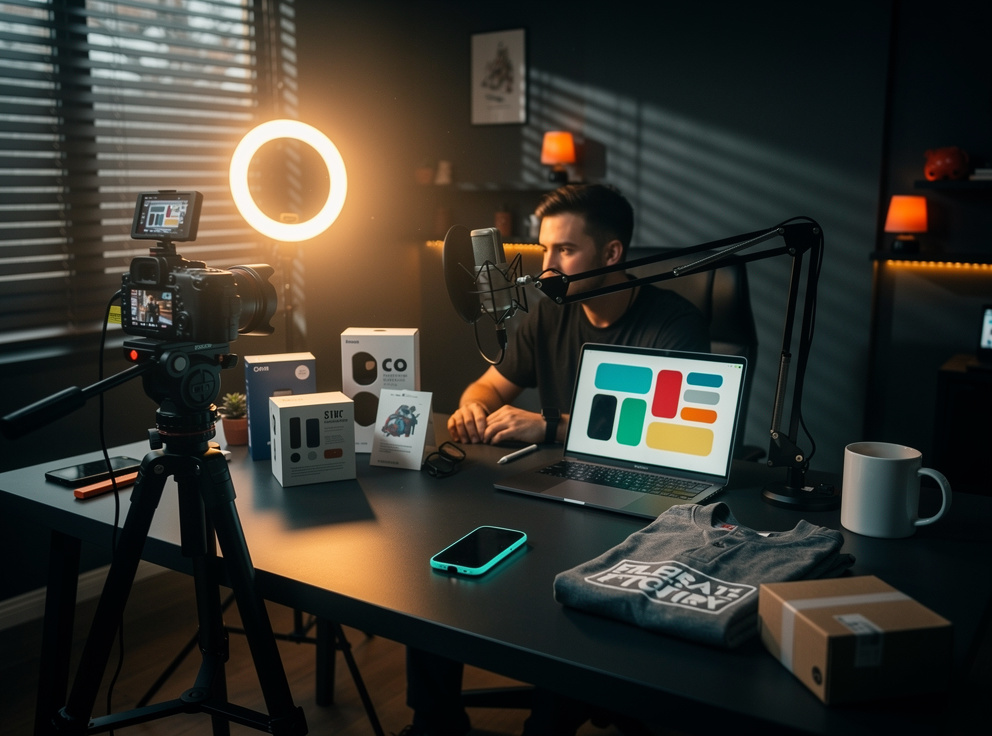
The creator economy runs on nine repeatable business models: advertising and platform revenue share, brand sponsorships, paid memberships, paid newsletters and premium media, digital products and courses, coaching and consulting, affiliate commerce, direct-to-consumer merchandise, and fan payments like tips and virtual gifts. The three that anchor most full-time creator businesses are brand sponsorships (the largest revenue pool, projected at $37 billion in U.S. creator advertising for 2025 per the IAB), paid memberships (predictable recurring income through Patreon and Substack), and digital products (the highest-margin scalable offer). The rest fill gaps depending on audience size, niche, and how much operational risk a creator will carry.
Think of these nine as a revenue stack, not a menu of one-off choices. Reach models (ads, sponsorships) bring scale but depend on algorithms. Retention models (memberships, newsletters) build recurring income you control. Commerce and expertise models (products, coaching, merch, affiliates) capture more value per fan. The strongest creator businesses layer several because consistent income rarely comes from one stream, a point creators on r/Entrepreneurs raise repeatedly.
The 9 creator economy business models at a glance
- Advertising and platform revenue share
- Brand sponsorships and ambassador programs
- Paid memberships and subscriptions
- Paid newsletters, podcasts, and premium media
- Digital products and online courses
- Coaching, consulting, and done-for-you services
- Affiliate commerce and social shopping
- Direct-to-consumer merchandise and creator brands
- Tips, crowdfunding, and fan payments
How we ranked these models
We evaluated each model on six criteria that decide whether it builds a durable business: revenue predictability, scalability, gross margin, operational complexity, algorithm dependence, and degree of customer ownership. Reach-based models scored high on scale but low on ownership and predictability. Owned-audience models scored the reverse. We weighted current 2026 platform thresholds, fees, and eligibility as practical entry points, and we favored models that give creators a direct relationship with their audience over ones that leave the platform in control.
| # | Model | Best for | Standout feature | Typical cost/fee |
|---|---|---|---|---|
| 1 | Advertising / rev share | High-volume video and podcast creators | Passive income at scale | YouTube: free to join, rev-share |
| 2 | Brand sponsorships | Niche creators with engaged audiences | Largest revenue pool | Varies; enterprise tools quote-based |
| 3 | Paid memberships | Creators with loyal superfans | Recurring monthly income | Patreon 10%; Substack 10% |
| 4 | Paid newsletters / media | Writers and analysts | Owned email list | Substack 10% of revenue |
| 5 | Digital products / courses | Experts with teachable skills | High margin, scalable | Teachable from $29/mo annual |
| 6 | Coaching / consulting | Specialists selling outcomes | Fastest to first revenue | Platform-dependent |
| 7 | Affiliate commerce | Reviewers and recommenders | No inventory risk | Commission-based |
| 8 | DTC merch / brands | Creators with strong identity | Highest value capture | Shopify from €27/mo |
| 9 | Tips / fan payments | Livestreamers and community builders | Monetizes high-intent fans | Platform fees vary |
Tip: A 2025 analysis by Barabási and colleagues found creator earnings across Instagram, Twitch, YouTube, Twitter, Facebook, and Patreon follow a power-law distribution with an exponent near 2, a rich-get-richer pattern. For smaller creators, that math is the argument for diversifying: relying on one reach-based platform concentrates risk you can't control.
1. Advertising and platform revenue share — best for high-volume video and podcast creators
Advertising and platform revenue share pays creators when platforms sell ads against their videos, livestreams, podcasts, and posts. It's the entry point most creators reach first because it requires no product, no pitch, and no inventory. The tradeoff is volatility and near-total algorithm dependence.
YouTube's Partner Program opens early monetization at 500 subscribers plus three public uploads in 90 days and either 3,000 long-form watch hours in a year or 3 million Shorts views in 90 days, per YouTube's official eligibility page. Full ad monetization requires 1,000 subscribers and either 4,000 watch hours or 10 million Shorts views. YouTube charges no monthly fee to join; earnings come through revenue-sharing.
Facebook paid creators nearly $3 billion in 2025, a 35% jump from the prior year, and 60% of those payouts went to Reels, according to Meta's Creator Fast Track announcement. Facebook Content Monetization remains invite-only and measures Qualified Views, Earnings Rate, and Non-Qualified Views.
Verdict: A necessary foundation for video creators, but never the whole business. Ad revenue swings with algorithm changes, so treat it as discovery fuel rather than a paycheck.
2. Brand sponsorships and ambassador programs — best for niche creators with engaged audiences
Brand sponsorships are direct deals where a company pays a creator for sponsored posts, product integrations, reviews, user-generated content, livestream appearances, or ongoing ambassador arrangements. This is the largest single revenue pool in the creator economy and the one growing fastest.
U.S. creator advertising is projected to hit $37 billion in 2025, up 26% year over year, per the IAB's 2025 Creator Economy Ad Spend & Strategy Report. That figure grew from $13.9 billion in 2021 to $29.5 billion in 2024 and is projected to reach $44 billion in 2026. In the same report, 48% of creator-ad buyers now call creators a must-buy.
Brands increasingly want measurable outcomes, not reach. Sponsored deals now hinge on conversions, incremental sales, usage rights, and performance attribution. Three out of four brands use or plan to use AI for creator-marketing tasks, per the IAB, and enterprise platforms like CreatorIQ (custom-quote pricing as of 2026) handle creator discovery, campaign management, and measurement for large advertisers.
Verdict: The biggest earner for creators who can prove results. Micro-influencers combining loyal audiences with brand deals are approaching or exceeding office salaries, a trend noted on r/popculturechat, though it's presented there as emerging rather than universal.
3. Paid memberships and subscriptions — best for creators with loyal superfans
Paid memberships turn a subset of your audience into recurring monthly revenue through exclusive content, private communities, bonus episodes, early access, and member-only perks. This model scores highest on predictability because income recurs instead of resetting each month.
Patreon Standard charges a 10% platform fee as of 2026 for pages published after August 4, 2025, plus payment processing, currency-conversion, and payout costs, per Patreon's creator fees overview. The plan includes memberships, annual billing, digital product sales, video hosting, chats, polls, and audience insights.
YouTube offers channel memberships alongside Super Chat, Super Stickers, and Super Thanks for eligible Partner Program creators, so members can be built into the same channel driving ad revenue.
Verdict: The most reliable recurring income for creators with a devoted core, even if that core is small. A few hundred paying members can outproduce hundreds of thousands of passive viewers.
4. Paid newsletters, podcasts, and premium media — best for writers and analysts
Paid premium media uses a free layer for discovery and a paid layer for analysis, archives, private podcasts, video, or group chats. Its defining advantage is ownership: an email list travels with you when a platform changes its rules.
Substack charges no displayed monthly software fee as of 2026 and keeps 10% of subscription revenue; creators keep 90% minus credit-card fees, per Substack's Going Paid page. Substack notes that 1,000 paid subscribers at $5 per month generate $60,000 in annual gross subscription revenue before fees, a benchmark that makes the model easy to plan around.
The economics reward depth over scale. You don't need viral reach; you need a defined audience willing to pay for professional information they can't get free elsewhere.
Verdict: The best ownership play for anyone whose value is expertise or judgment. Adjacent lifestyle publishers like GQ and InsideHook lean on the same free-to-paid newsletter mechanics, and it works because the audience relationship is direct.

5. Digital products and online courses — best for experts with teachable skills
Digital products are repeatable intellectual property: courses, templates, ebooks, downloads, workshops, cohorts, and databases. This model has the highest gross margin in the stack because you build once and sell repeatedly with near-zero marginal cost.
Teachable Starter costs $39 monthly or $29 per month billed annually as of 2026, supports five products, and charges a 7.5% transaction fee, per Teachable's pricing page. Builder ($89 monthly, $69 annual) supports 10 products and advertises 0% transaction fees through eligible Teachable payment options; Growth ($189 monthly, $139 annual) supports 50 products.
Kajabi sits at the higher end. Basic costs $179 monthly or $143 annual with five products and 2,500 contacts; Growth runs $249 monthly or $199 annual with 50 products; Pro reaches $499 monthly or $399 annual with unlimited products and 100,000 contacts.
Verdict: The best scalable-margin model once you have proof of demand. Validate the topic with a smaller offer first, because building a full course before anyone's asked for it is the most common wasted effort here. For a broader view on turning skills into income, see 10 ways you can grow your creativity using online learning apps.
6. Coaching, consulting, and done-for-you services — best for specialists selling outcomes
Coaching and consulting sell your expertise directly through audits, implementation, group programs, and done-for-you work. This model produces revenue faster than any scalable product because you're selling time and knowledge you already have, no build required.
The tradeoff is scalability. Every dollar is tied to your hours unless you productize the service into cohorts, templates, retainers, or repeatable packages. Margin is high per engagement but capped by your calendar.
For creators in a specialized field, services also double as market research. Client questions tell you exactly which digital product to build next, which is why many creators use consulting as a bridge to higher-margin products.
Verdict: The fastest path to meaningful income for a genuine expert, and the slowest to scale. Community critics on r/asianamericanytsnark warn against creators monetizing the fantasy of success rather than real outcomes, so this model only holds up when the expertise is real. If you're formalizing a service business, 3 steps to protect your freelance business is worth a read.

7. Affiliate commerce and social shopping — best for reviewers and recommenders
Affiliate commerce earns creators commissions through tracked links, product tags, storefronts, and discount codes, with no inventory to hold. It's the lowest-risk commerce model because you never touch fulfillment, returns, or working capital.
YouTube Shopping is available to eligible creators at the 500-subscriber Partner Program threshold when other requirements are met, letting reviewers tag products directly in videos. The model suits creators whose audiences already come for recommendations, which is exactly how lifestyle publishers like Gear Patrol and The Manual structure their commerce content around buying guides and reviews.
The catch is dependence on someone else's economics. Commission rates, cookie windows, and program terms are set by the merchant, and a rate cut can halve your income overnight.
Verdict: The best starting point for commerce because it carries no financial risk. It rewards trust: audiences buy through creators who recommend honestly, which is the foundation of every credible product-review business.
8. Direct-to-consumer merchandise and creator brands — best for creators with strong identity
Direct-to-consumer merchandise lets creators sell physical products they own: apparel, cosmetics, food, equipment, collectibles, and books. Compared with affiliate commerce, DTC captures far more customer value because you own the margin, but it adds inventory, fulfillment, customer service, regulatory, and working-capital risk.
Shopify anchors most creator brands. On its European pricing page as of 2026, Basic costs €27 per month, Grow €79, Advanced €289, and Plus starts at €2,100 per month. Capabilities span online and in-person selling, social and marketplace channels, checkout, payments, shipping, and analytics.
This is the highest-ceiling, highest-complexity model. A hit product line can outearn every other stream combined, but a warehouse full of unsold inventory is a real way to lose money in the creator economy.
Verdict: The best value-capture model for creators with a distinct brand identity and the appetite to run operations. Start with affiliate or print-on-demand before committing capital to owned inventory.
Warning: Merch and DTC introduce risks the other eight models don't: physical inventory, fulfillment logistics, product-safety regulation, and cash tied up before you sell a unit. Creators on r/CreatorEconomy describe juggling multiple revenue streams as backend chaos. Adding a physical-products operation multiplies that complexity, so don't launch it as your first model.
9. Tips, crowdfunding, and fan payments — best for livestreamers and community builders
Fan payments monetize high-intent participation rather than passive reach: tips, crowdfunding, virtual gifts, paid livestream access, Super Chats, Super Stickers, Super Thanks, and one-time purchases. These convert your most engaged fans at the exact moment they want to support you.
YouTube's live-payment tools let creators earn during streams without a sponsor or product. The revenue is lumpy and event-driven, so it works best as a supplement layered on top of a livestreaming or community habit rather than a primary income line.
The advantage is immediacy and low setup. There's no product to build and no brand to pitch; if you have an engaged live audience, you can turn on fan payments today.
Verdict: The best supplemental layer for creators who show up live. It won't carry a business alone, but it captures value from superfans that ads and sponsorships leave on the table.
Other options and adjacent approaches
Two adjacent paths deserve a mention. Licensing lets established creators earn by licensing their name, format, or content to other businesses, though it typically requires a brand valuable enough for partners to pay for. And enterprise creator-marketing platforms like CreatorIQ, whose 2026 State of Creators report surveyed 5,095 creators across 100 regions, sit on the brand side of the sponsorship model rather than being a creator revenue stream themselves. In that survey, Instagram ranked first for long-term creator-business potential at 38%, ahead of TikTok at 35% and YouTube at 23%.
Lifestyle-media publishers show how these models combine at scale. Thrillist leans on destination and food discovery with branded content; GQ blends authority journalism with fashion commerce, memberships, and premium sponsorships. At Theindustryofcool, a lifestyle media publication, the same logic runs through our travel, food, fashion, sports, collectibles, and tech guides: editorial authority earns trust, and trust is what makes every commerce and recommendation model work.
Frequently asked questions
What is the most profitable creator economy business model?
Brand sponsorships command the largest revenue pool, with U.S. creator advertising projected at $37 billion in 2025 per the IAB. But "most profitable" depends on your audience. Digital products and courses carry the highest margins because they're built once and sold repeatedly, while a strong direct-to-consumer product line can capture the most value per customer. For most creators, sponsorships plus one owned-audience model (memberships or products) beats any single stream.
How many revenue streams should a creator have?
Most sustainable creator businesses run three to five streams, typically one reach-based model for discovery, one recurring model for retention, and one high-margin offer for monetization. Creators on r/Entrepreneurs consistently report that steady income rarely comes from one channel. Start with the model that fits your current audience, prove it works, then layer the next one rather than launching everything at once.
What is the difference between affiliate commerce and DTC merchandise?
Affiliate commerce earns commissions on products you don't own, with no inventory, fulfillment, or working-capital risk. Direct-to-consumer merchandise means selling products you own outright, which captures far more margin but adds inventory, shipping, customer service, and regulatory obligations. Affiliate is the low-risk entry point; DTC is the higher-ceiling, higher-complexity option best attempted after you've validated demand.
How much does it cost to start a paid membership or newsletter?
Both Patreon and Substack charge a 10% platform fee as of 2026 with no upfront monthly software cost, so you only pay when you earn. Substack notes that 1,000 subscribers at $5 per month produce $60,000 in annual gross revenue before fees. Course platforms cost more: Teachable starts at $29 per month billed annually, and Kajabi Basic runs $143 per month annually.
Why is diversifying creator revenue so important?
A 2025 academic analysis by Barabási and colleagues found creator earnings follow a power-law distribution with an exponent near 2, a rich-get-richer pattern where a small number of creators capture most of the money. Relying on one platform's algorithm concentrates that risk. Combining reach, retention, and ownership models protects smaller and mid-tier creators from a single algorithm change or program cut wiping out their income.
Which platforms have the best long-term potential for creators?
In CreatorIQ's 2026 State of Creators report, which surveyed 5,095 creators across 100 regions, Instagram ranked first for long-term business potential at 38%, followed by TikTok at 35% and YouTube at 23%. The better strategy is to use platform reach for discovery and move fans to owned channels like email and communities, where you control the relationship regardless of which platform leads next.
Related Reading
- 10 Best Lifestyle Magazines Covering Travel, Food, and Fashion
- Tech Accessories Statistics 2026: 40 Numbers That Matter
- How to Find Unique Travel Destinations Beyond the Usual Tourist Routes
- Top 8 Tech Accessories for a More Productive Desk
- The Best Websites for Discovering Cool Travel Destinations
- Stylish Small-Space Storage Solutions That Make Every Room Work Harder
- America’s Best Ski Resorts for 2026, From Powder to Après-Ski
- Boost Your Productivity With All-in-One Computers: Must-Have Features
- Does Your Home Need Revamping?